What Are Prime Numbers? The Elegant Building Blocks of Mathematics
Discover what prime numbers are, why they matter in math, technology, and nature, and explore the unsolved mysteries that still puzzle mathematicians today.
PURE MATHEMATICS
Anupam Nigam
11/2/20253 min read
What Are Prime Numbers? The Elegant Building Blocks of Mathematics
At first glance, prime numbers seem like a simple idea from elementary math. But look closer, and you’ll find they’re among the most profound and powerful concepts in all of science. From securing your online messages to shaping patterns in nature, prime numbers quietly influence our world in ways most of us never notice.
So, what exactly are they—and why do they matter so much?
What Is a Prime Number?
A prime number is a natural number greater than 1 that cannot be formed by multiplying two smaller natural numbers. In simpler terms: it has exactly two distinct positive divisors—1 and itself.
Examples:
2 is prime (only 1 × 2)
3 is prime (only 1 × 3)
4 is not prime (2 × 2)
17 is prime
1 is not considered prime (it has only one divisor)
The sequence begins:
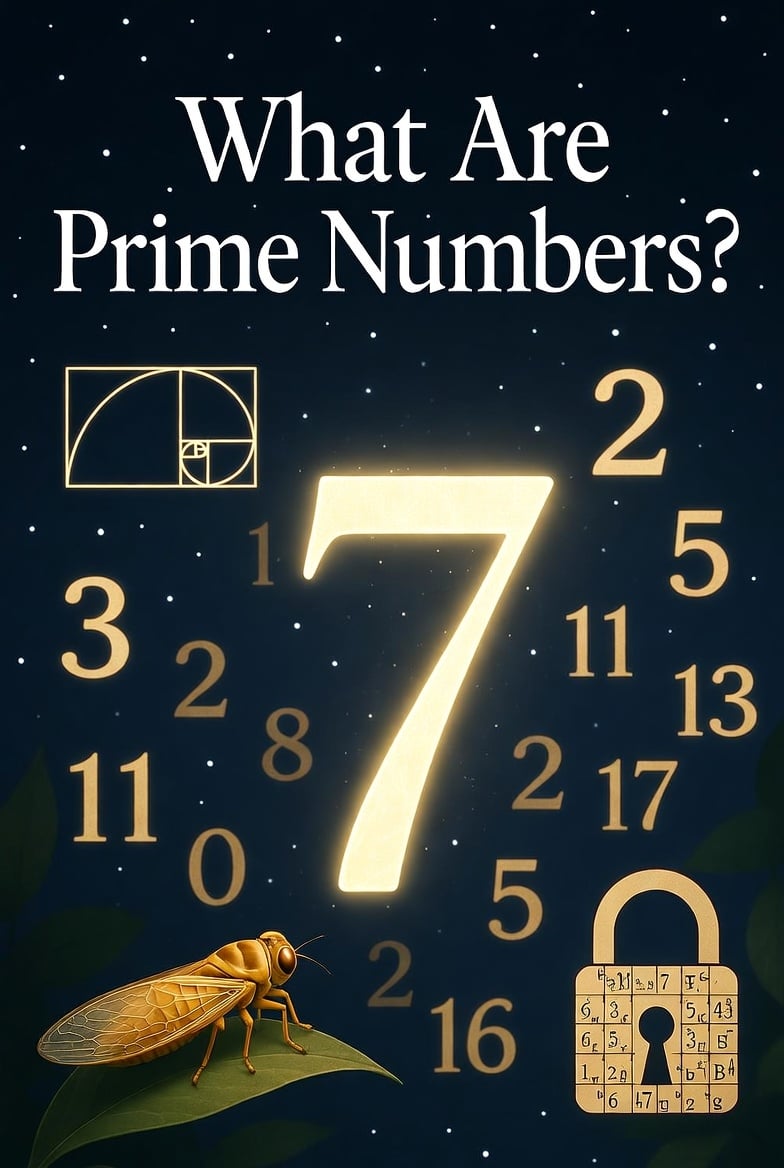
2, 3, 5, 7, 11, 13, 17, 19, 23, 29, 31…
Fun fact: 2 is the only even prime number. All other even numbers are divisible by 2, so they’re automatically composite.
Why Are Prime Numbers Important?
1. The Foundation of Arithmetic
Prime numbers are often called the “atoms” of mathematics. Just as every molecule is made of atoms, every integer greater than 1 can be uniquely expressed as a product of prime numbers. This is known as the Fundamental Theorem of Arithmetic .
For example:
60 = 2 × 2 × 3 × 5
1001 = 7 × 11 × 13
This unique “prime factorization” is essential in number theory, algebra, and computer algorithms.
2. Cryptography and Cybersecurity
One of the most critical modern uses of prime numbers is in encryption —especially public-key cryptography like the RSA algorithm .
Here’s how it works (simplified):
Two very large prime numbers are multiplied to create a massive composite number.
This composite number is used as a public key to encrypt data.
Only someone who knows the original primes can efficiently decrypt the message.
Because factoring huge numbers into their prime components is computationally extremely difficult (even for supercomputers), this system keeps your emails, bank transactions, and private messages secure.
3. Computer Science & Algorithms
Prime numbers help optimize:
Hash tables (to reduce collisions in data storage)
Error-correcting codes in digital communications
Their irregular distribution makes them ideal for creating systems that need unpredictability and uniformity at the same time.
4. Nature and Biology
Surprisingly, prime numbers appear in the natural world.
Periodical cicadas in North America emerge every 13 or 17 years—both prime numbers. Scientists believe this evolutionary strategy helps them avoid syncing with the life cycles of predators (which often have 2-, 3-, or 6-year cycles).
5. Music, Art, and Design
Composers like Olivier Messiaen used prime numbers to create non-repetitive musical rhythms.
In visual art, primes help generate patterns that feel organic and never quite repeat—ideal for minimalist or generative design.
Are There Infinite Prime Numbers?
Yes! Around 300 BCE, the ancient Greek mathematician Euclid proved that there are infinitely many primes. His elegant proof remains one of the earliest examples of mathematical reasoning still taught today.
But while we know primes never end, we still don’t fully understand how they’re distributed.
Unsolved Mysteries: The Open Questions
Despite centuries of study, prime numbers continue to baffle mathematicians. Here are some famous unsolved problems:
🔹 The Riemann Hypothesis
Perhaps the most important open problem in mathematics. It deals with the distribution of prime numbers and is deeply connected to the zeros of the Riemann zeta function. A correct proof would revolutionize number theory—and earn a $1 million prize from the Clay Mathematics Institute.
🔹 Twin Prime Conjecture
Are there infinitely many pairs of primes that differ by 2? (Like 3 & 5, 11 & 13, or 101 & 103?)
In 2013, mathematician Yitang Zhang made a breakthrough—but the gap of 2 remains unproven.
🔹 Goldbach’s Conjecture
Every even integer greater than 2 can be expressed as the sum of two primes.
Example: 10 = 3 + 7, 24 = 11 + 13
It’s been verified for numbers up to 4 × 10¹⁸—but no general proof exists.
The Future of Prime Numbers
As computing power grows, so does our ability to find and use massive primes. Projects like GIMPS (Great Internet Mersenne Prime Search) rely on volunteers worldwide to discover new record-breaking primes—often Mersenne primes (primes of the form 2ᵖ − 1).
Meanwhile, quantum computing poses both a threat and an opportunity:
Shor’s algorithm could one day break current prime-based encryption.
But it may also unlock new ways to explore prime distribution and solve long-standing conjectures.
Final Thought: Simplicity That Shapes the World
Prime numbers are a perfect blend of simplicity and depth. You can explain them to a child, yet they guard secrets that challenge the greatest minds on Earth. They are timeless, universal, and quietly essential—woven into the fabric of math, technology, and even life itself.
So the next time you send a secure message, hear an unusual rhythm in music, or watch cicadas emerge after 17 years, remember: prime numbers are at work—silent, indivisible, and indispensable.